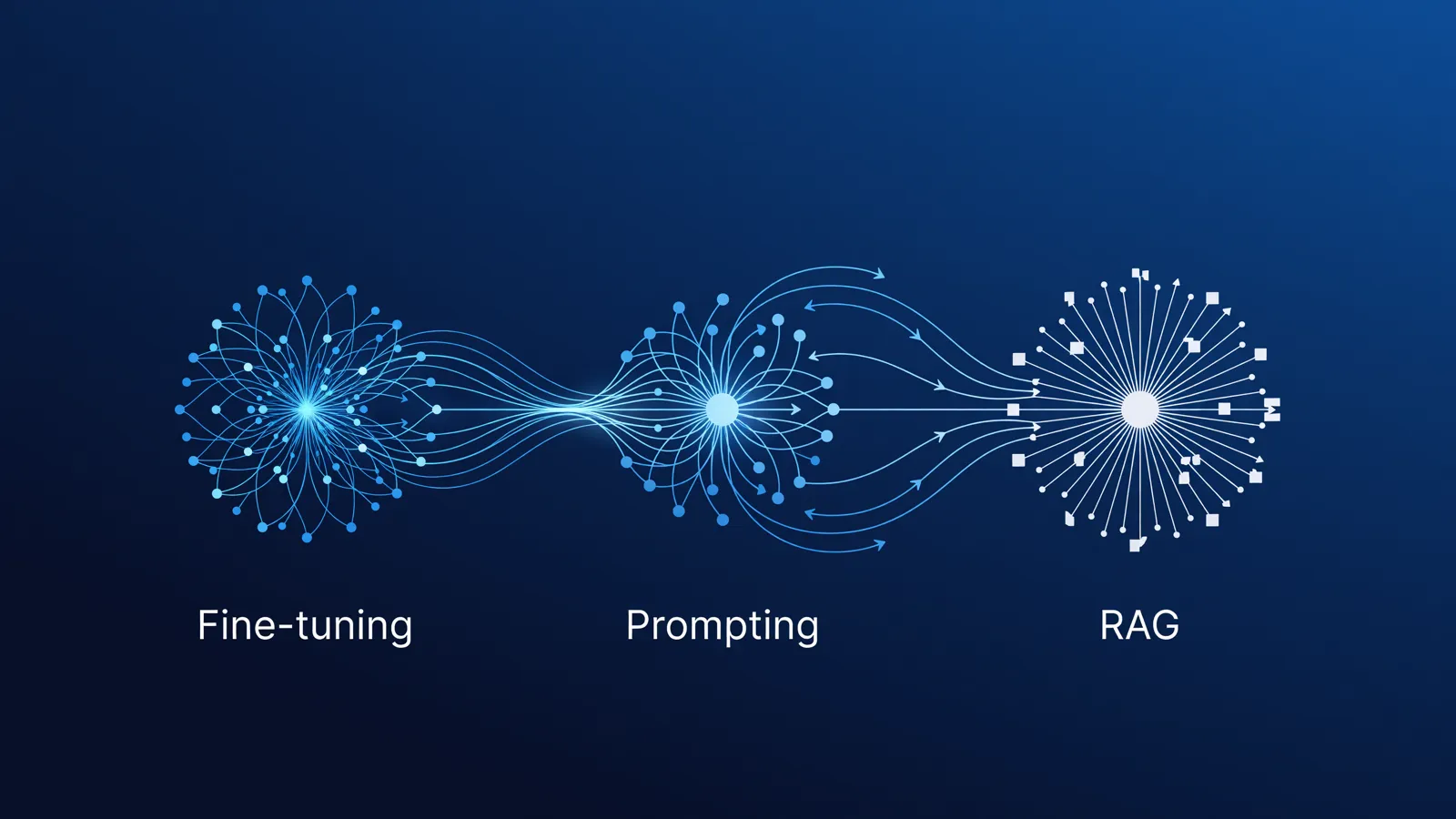
Fine-tuning versus prompting: when should you train?
What you should know beforehand: This article is part of Module 4 (Adapting a model) of the learning path. Basic knowledge of how weights work and how tokens are processed is helpful; consult the overview in the AI glossary of foundational concepts to clarify definitions around adapters, loss, and embeddings. Also check out the broader architectural trade-offs in the overview article on fine-tuning versus prompting and RAG.
When developing AI-powered applications, a fundamental architectural question quickly arises: do you solve a task by passing instructions and examples within the prompt, or do you directly adjust the weights of the underlying language model via fine-tuning? In practice, prompt engineering proves to be the right starting point for the vast majority of use cases. However, providing context within prompts has hard physical and economic limits. As soon as consistency, latency, strict output formats, or scale become the bottleneck, the balance inevitably shifts toward training.
In this article, we examine the technical, financial, and operational factors that determine when to stop prompting and start training. We analyze the mechanical difference between steering in-context versus steering model weights, compare total cost of ownership (TCO), and cover common pitfalls regarding data quality and model degradation.
1. The mechanical difference: working memory versus muscle memory
To determine which strategy fits, we need to look at what happens computationally during inference. When steering a model via prompting (including zero-shot, few-shot, and chain-of-thought), you rely exclusively on its so-called in-context learning capability. All guiding information, rules, and example interactions reside within the context window. Using attention mechanisms, the transformer architecture calculates the relationships between these tokens. The internal model weights do not change by even a fraction during this process. In effect, you are renting temporary computational working memory with every API call.
With fine-tuning, on the other hand, the weights in the neural layers are actually updated via gradient descent (backpropagation) based on a curated dataset. As a result, the model permanently learns to recognize and reproduce statistical patterns, specific syntax, writing styles, and domain-specific terminology structures. While prompting can be compared to handing a manual to a temporary worker for a one-off task, fine-tuning is like structurally training a permanent employee until the actions become second nature.
This distinction has direct implications for reliability. Instructions in prompts can compete with earlier instructions within the same prompt, suffer from the 'lost in the middle' effect in long contexts, or be ignored when handling complex logic. A fine-tuned model has the desired behavior anchored in its parameters, drastically reducing the likelihood of deviations from the defined format.
2. When Prompting Is Superior
Prompting is the preferred route for testing hypotheses, rapid iteration, and tasks that require a wide range of dynamic knowledge. As long as the task specification is still evolving, training a model is counterproductive. Modifying and immediately testing a prompt takes just a few seconds, whereas collecting training data, formatting, training, and evaluating takes hours to days.
The primary situations where prompting remains the best choice:
- Volatile factual knowledge: A language model is not a relational database. Facts that change weekly or daily (such as product prices, inventory levels, or recent legal amendments) belong in a dynamic context via RAG or API calls, not in frozen weights.
- Low to medium call volumes: As long as an application processes thousands rather than millions of requests per day, the operational costs of training infrastructure and dedicated model management rarely outweigh the simplicity of an off-the-shelf commercial foundation model.
- Generic reasoning tasks: Large frontier models possess an enormous pre-training corpus with general reasoning skills that cannot easily be matched by fine-tuning a smaller model on a small custom dataset of 500 examples.
- Rapid experimentation and validation: For systematically comparing different instruction sets, you can utilize rigorous testing methods; consult the guide on A/B testing prompts to discover how to measure statistically significant quality differences before considering training.
3. Hard Triggers for Fine-Tuning
When does prompting hit its limits? In production environments, there are four concrete tipping points that make training a custom model necessary or economically viable.
A. Token waste and context reduction
If you need to include 1,500 tokens of system prompts, edge-case rules, and few-shot examples with every API call just to force an 80-token JSON response, you are paying 95 percent of your operational token costs purely for overhead. By training the model on those specific input-output relationships, you reduce the system prompt to a few tokens (such as just the task name), plummeting latency and potentially reducing per-transaction processing costs by a factor of ten to twenty.
B. Strict formatting and syntactic determinism
While structured outputs (JSON Schema mode) in major APIs resolve many issues, generic models regularly fail on exotic DSLs (Domain Specific Languages), obscure XML schemas, or complex SQL dialects. Fine-tuning programs the grammar of the desired output directly into the network's token selection, virtually eliminating syntax errors without requiring extensive retry loops.
C. Domain-specific tone, style, and jargon
In regulated markets, such as Dutch medical reporting or the notarial profession, phrasing matters tremendously. A prompt like "write in a formal legal style" often results in overly archaic or cliché language. Fine-tuning on tens of thousands of anonymized, authentic documents ensures an accurate replication of the desired register, without having to write out every stylistic rule explicitly.
D. Privacy, Sovereignty, and Local Hardware
When data is not permitted to leave local servers or the European cloud zone due to strict GDPR regulations, using closed US cloud APIs is out of the question. A compact open-source model (such as an 8B or 14B model) often falls short out-of-the-box on specialized tasks. By selectively fine-tuning such a compact model, it can match or exceed the quality of a cloud model ten times its size on a single specific task, while running locally on affordable hardware.
4. Comparison Matrix: Prompting vs. Fine-Tuning
The table below contrasts the two approaches across key architectural dimensions:
| Dimension | Prompt Engineering | Fine-Tuning (SFT / LoRA) |
|---|---|---|
| Development Speed | Minutes to hours; immediate feedback loop. | Days to weeks; requires data labs and evaluation pipelines. |
| Data Requirements | 0 to 10 high-quality examples (few-shot). | Hundreds to tens of thousands of curated pairs. |
| Cost per API Call | High with long system prompts and numerous examples. | Very low due to minimal input context. |
| Upfront Investment | Negligible (no GPU training time). | Moderate to high (compute and data labeling). |
| Knowledge Recency | Instantly up-to-date via RAG and real-time context. | Static as of the training cutoff date. |
| Style and Format Consistency | Moderate to good (risk of drift with long context). | Very high; structurally anchored in model weights. |
| Latency | Higher due to TTFT (Time To First Token) on large prompts. | Low; minimal input processing time. |
5. The Economic Tipping Point: Calculating TCO
In a production environment, choosing between both techniques is often a matter of straightforward math. Let's look at a realistic scenario involving a specialized classification and extraction task:
Suppose an organization processes 100,000 customer interactions daily. Under a prompting strategy using one of the latest commercial frontier models from major providers, each call includes a robust system prompt with edge cases amounting to 1,200 tokens, alongside an output of 100 tokens. As an illustrative calculation (reference date August 24, 2026; always verify current rates with your provider), we assume roughly €3 per million input tokens and €15 per million output tokens. The daily costs are then:
Input:  100.000 calls * 1.200 tokens = 120.000.000 tokens / 1M * €3,00 = €360,- per dag
Output: 100.000 calls *   100 tokens =  10.000.000 tokens / 1M * €15,00 = €150,- per dag
Totaal per dag: €510,-  -->  Jaarlijkse kosten: circa €186.150,-
If we opt instead for a fine-tuned 8B open-source model (such as Llama 3 or Mistral), the input prompt can be reduced to just the raw source text (averaging 200 tokens). The one-time training costs amount to a few hundred euros in GPU rentals, plus the labor for data curation. The model then runs on two rented dedicated instances at approximately €1.20 per hour:
Hosting: 2 servers * 24 uur * €1,20/uur = €57,60 per dag
Totaal per dag: circa €58,-  -->  Jaarlijkse kosten: circa €21.170,-
In this scenario, the savings exceed €160,000 annually. For those who want to dive deeper into these trade-offs: check out the comprehensive dossier at the comparison page on quality versus cost to see how latency, model size, and token pricing interact with each other.
6. Training Methods: from Full Fine-Tuning to PEFT
When the decision is made to start training, you rarely need to adjust all billions of parameters in a model. Full Fine-Tuning (where all weights are updated) requires enormous amounts of VRAM and introduces high risks of overfitting. In modern AI engineering, Parameter-Efficient Fine-Tuning (PEFT), and specifically LoRA (Low-Rank Adaptation), has become the industry standard.
With LoRA, the base model's original weight matrices are frozen. Small, trainable adapter matrices are placed in parallel with the attention and feed-forward layers. As a result, you only need to train 0.1% to 1% of the total parameter count. For the exact mathematical mechanics and memory calculations, read the in-depth explanation of LoRA and adapters.
Below, we see what a typical training record for supervised fine-tuning (SFT) looks like in the standard ChatML/JSONL format:
{
  "messages": [
    {
      "role": "system",
      "content": "Je bent een gespecialiseerde parser voor Nederlandse notariële akten. Extraheer partijen en registergoed in compact JSON-formaat."
    },
    {
      "role": "user",
      "content": "Vandaag, vijftien augustus tweeduizend zesentwintig, verscheen voor mij, mr. J. de Vries, notaris te Alkmaar: de heer Pieter Bakker, geboren te Haarlem..."
    },
    {
      "role": "assistant",
      "content": "{\"notaris\":\"J. de Vries\",\"standplaats\":\"Alkmaar\",\"datum\":\"2026-08-15\",\"partijen\":[{\"naam\":\"Pieter Bakker\",\"geboorteplaats\":\"Haarlem\"}]}"
    }
  ]
}
By feeding the model with 1,000 to 5,000 of such high-quality examples, it learns to execute the extraction logic autonomously without requiring extensive rule definitions in the prompt.
7. The Risks: Alignment Degradation and Catastrophic Forgetting
Fine-tuning is not without risk. While a poorly crafted prompt merely results in a single failed API call, a mis-trained model can suffer structural damage to its fundamental capabilities. This phenomenon is known as catastrophic forgetting (catastrophic forgetting).
When a model is trained too intensively on a narrow task (for example, exclusively summarizing legal contracts), the optimization algorithm overwrites neural pathways responsible for general logical reasoning, multilingual capabilities, or basic arithmetic. The model becomes a specialist, but loses its ability to interpret contextual nuances outside that niche. To understand how to mitigate this using regularization and mixed datasets, read the article on preventing catastrophic forgetting in fine-tuning.
Additionally, fine-tuning can inadvertently weaken the base model's built-in safety filters (safety alignment). A model carefully trained during its pre-training and RLHF phases to avoid generating malicious code or sensitive personal data may lose these restrictions if the fine-tuning dataset is not meticulously filtered for compliance.
8. The Hybrid Route: RAG Combined with Fine-Tuning
In mature production systems, the choice is rarely binary. The most powerful architectures combine fine-tuning with Retrieval-Augmented Generation (RAG). In this setup, both techniques play complementary roles:
- The fine-tuned adapter acts as the structural and stylistic expert: the model knows precisely how to reason within the domain, how to structure source citations, and in what format the response must be delivered.
- The RAG system injects the latest dynamic documents into the context: it provides the factual ground truth for the specific case.
Furthermore, a fine-tuned model can be specifically trained to handle RAG contexts more effectively. While an off-the-shelf foundation model sometimes struggles with irrelevant retrieval results (noise), a trained model can learn to ignore conflicting sources and rely exclusively on verified context chunks.
In modern software environments, we see engineers integrating these techniques into autonomous agent architectures. If you want to know how these roles are evolving in the market, read the dossier on how to become an AI agent engineer in 2026 for insights across the entire spectrum, from prompting to model architecture.
9. Practical Decision Tree
To determine which approach is right for a project at this stage, the following step-by-step framework can serve as a guide:
- Always start with prompting: Build a prototype using a leading commercial model (for instance, via zero-shot or few-shot prompting). Validate whether the task is computationally feasible for an LLM in the first place.
- Optimize the prompt and context: Use structured formats, chain-of-thought prompting, and add RAG if domain-specific knowledge is missing. Measure baseline quality using a fixed evaluation dataset.
- Analyze the bottlenecks:
- Is the quality sufficient, but the costs or latency are too high at scale? → Fine-tune a smaller open-source model on the outputs of the larger model (distillation).
- Does the model still structurally fail on syntax or style despite extensive prompting? → Fine-tune on 500 to 2,000 curated examples.
- Must the data remain strictly on-premises due to regulatory compliance? → Fine-tune a local open-weights model using LoRA.
- Evaluate continuously: Always benchmark the fine-tuned model against the original prompting baseline on both task-specific performance and general reasoning capabilities to rule out regression.
Next steps: Now that we have mapped out the trade-offs between prompting and training, the logical next step is exploring specific training protocols. Check out the guide on LoRA and parameter-efficient adapters or dive deeper into methods for managing regression during fine-tuning.