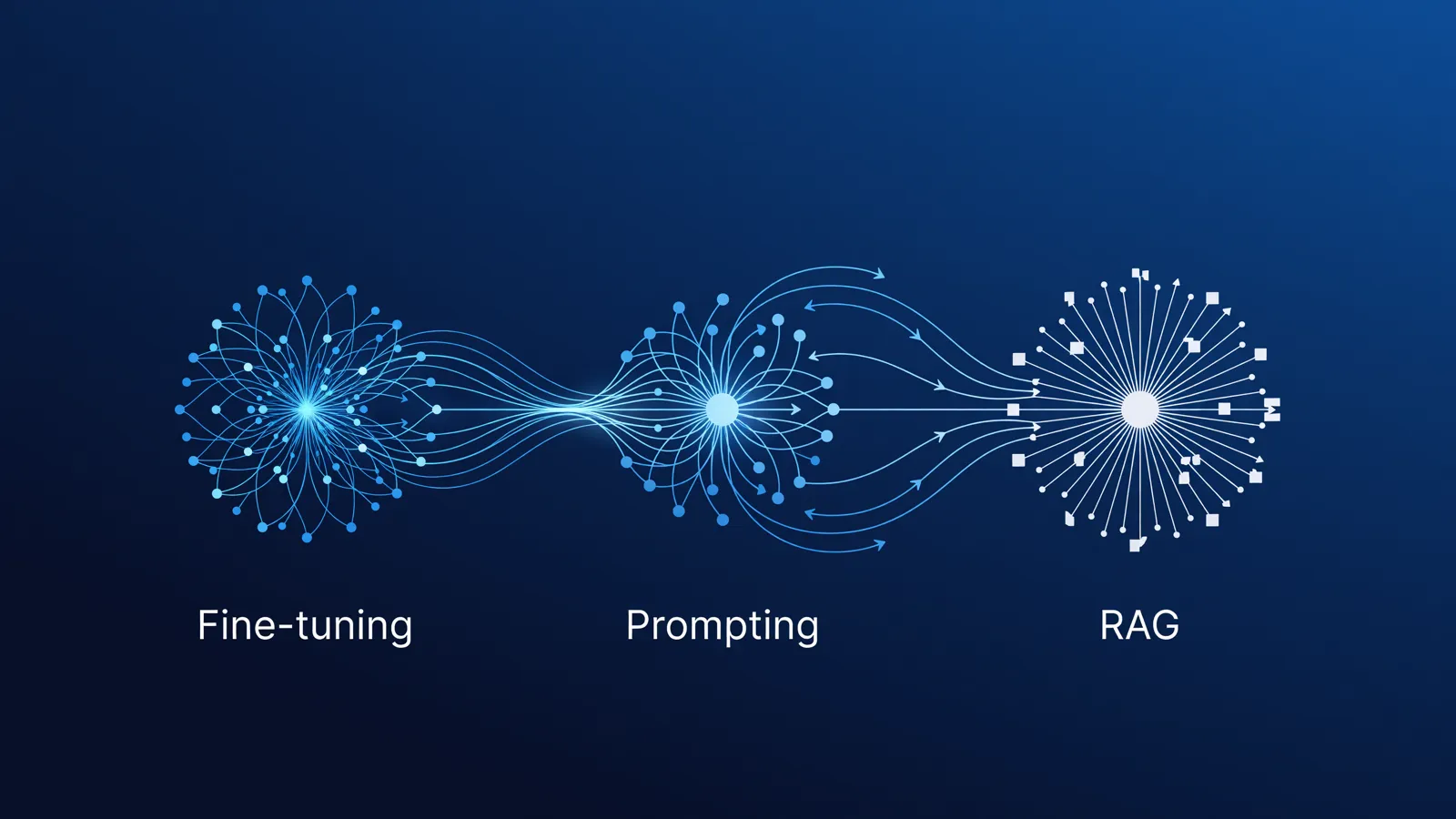
1. Introduction: The Three Pillars of LLM Interaction
When building an application based on Large Language Models (LLMs), you quickly face a fundamental architectural choice. How do you ensure the model provides relevant, correct, and context-specific answers?
In practice, almost all solutions fall back on three fundamental approaches:
1. Prompting
Providing instructions and examples directly in the input text (in-context learning) without external data or weight adjustments.
2. RAG
Retrieval-Augmented Generation: retrieving external documents via vector searches and dynamically adding them to the prompt.
3. Fine-tuning
Permanently adjusting the model weights through training on a specific dataset.
Each method has its own balance between development complexity, operational costs, maintainability, and accuracy. No single method is universally superior; it depends entirely on your use case.
2. Conceptual Differences & Deep Dive
Prompting (In-Context Learning)
With pure prompting, you rely entirely on the internal parameters (the "worldview") that the model acquired during pre-training. You guide its behavior using System Prompts, few-shot examples, and restrictive instructions.
-
Strengths: Instantly implementable, requires no infrastructure for data retrieval or model training.
Limitations: Prone to hallucinations with obscure facts; limited by the model's maximum context length.
Retrieval-Augmented Generation (RAG)
RAG links the LLM to an external knowledge source (such as a database or document archive). When a user asks a question, a vector search engine searches the database for relevant snippets. These snippets are then added to the prompt as context (Context + Prompt → LLM).
-
Strengths: Ideal for up-to-date, changing, or extensive documentation; source attribution is easily possible; lower costs than fine-tuning for factual knowledge.
Limitations: Dependent on the quality of the retriever (chunking, embeddings, hybrid search); additional infrastructure and latency.
Fine-tuning
With fine-tuning, you take an existing model and train it further on a specialized dataset. This changes the actual weights of the neural network. This is primarily intended to teach the model a specific tone, a unique style, or a specific response format (such as JSON schemas), rather than to add factual knowledge.
-
Strengths: Consistent output style, more efficient for highly specific formats, reduces the required prompt length because instructions are "baked in".
Limitations: High initial costs, requires high-quality training data, model knowledge quickly becomes static (outdated).
3. Costs, Complexity & Comparison
A clear overview of the operational and technical implications helps in weighing the right architecture:
| Dimension | Prompting | RAG | Fine-tuning |
|---|---|---|---|
| Initial Complexity | Very low | Medium / High | High |
| Infrastructure | LLM API only | Vector DB + Embedding Pipeline | Training Pipeline + Hosting / Managed Tuning |
| Data update frequency | Immediate (via prompt) | Real-time (database update) | Slow (requires new training cycle) |
| Cost structure | Inference tokens only | Inference + Vector storage + Embedding API | One-off training time + Higher hosting/inference costs |
| Primary goal | General tasks & logic | Factual knowledge & document processing | Style, tone, structure & domain-specific jargon |
4. The Decision Tree
Use the step-by-step structure below to determine which technique fits your project:
- Does the model need to rely on specific, private, or dynamic company documents?
- Yes → Choose RAG (optionally combine with prompting for the system description).
- No → Go to step 2.
- Does the task require a highly specific output format (e.g., strict JSON output), a specific writing style, or consistent behavior that cannot be achieved sufficiently with standard instructions?
- Yes → Consider Fine-tuning.
- No → Go to step 3.
- Does a clear instruction, a few examples (few-shot), and a powerful base model solve the problem?
- Yes → Choose pure Prompting (the simplest and cheapest option).
- No → Re-evaluate the scope or combine RAG with advanced prompting.
5. Practical Exercise
Case Study: Internal Customer Service Bot
Scenario: You are building an AI assistant for a technical wholesaler. The bot needs to answer questions about current stock status, technical manuals from 400 different suppliers, and respond in the company's formal, friendly brand voice.
Assignment: Determine which combination of techniques you will use and justify your choice based on:
- How will you handle the technical manuals and stock data?
- How will you ensure the correct brand voice and tone?
- Why is one of the three methods immediately ruled out as a primary solution for the product information?
Need help with your LLM architecture?
Whether you choose a robust RAG pipeline or a targeted fine-tuning strategy, we help you make the right choices from concept to production.
View our consultancy services